Ward daily schedule
One Flew Over the Cuckoo's NestThe Ward daily schedule turns ordinary care into a system of regulated movement. Organized through coded Order Daily Cards and carried out under Nurse Ratched’s authority, it assigns patients times, places, tasks, and treatments from morning onward. In Chief Bromden’s account, its power lies not only in the appointments it imposes but in making ward life seem mechanical: a routine that can be accelerated, frozen, and briefly unsettled when its control falters.
Design and enforcement
The day is prepared in advance from notes Nurse Ratched makes about the patients. These notes are typed into a machine behind a steel door at the Nurses’ Station, and the resulting Order Daily Cards return punched with patterns of small square holes. At the start of the day, a properly dated card is inserted into a slot; the walls hum, and the prescribed routine begins. The schedule thus appears less like a posted list than a program that activates the ward.
Its authority is distributed among machinery, staff, and the patients’ assigned routines. The cards determine when lights come on, when patients are moved, and when activities begin. At eight o’clock, a ceiling speaker announces medication in Nurse Ratched’s voice even while she is away from the microphone, preparing a drug tray nearby. The announcement makes her authority seem present throughout the ward, while the orderly procession to receive medication places patients into categories and queues.
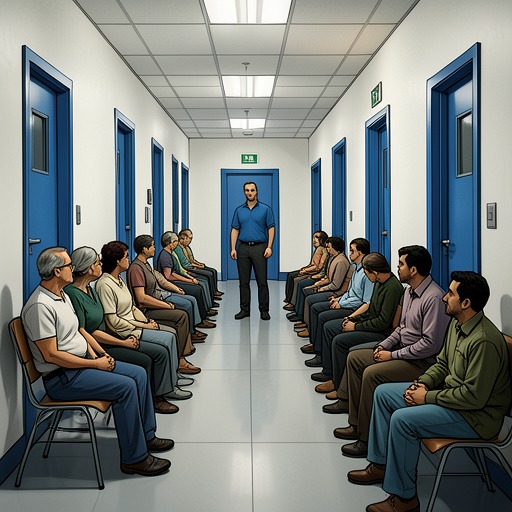
Bromden depicts the patients as repeatedly sorted by their condition and capacity. Those able to walk shave after the acute patients; patients who use wheelchairs wait until later, and the most dependent patients are attended to separately. This ordering makes differences in mobility part of the timetable itself. The schedule does not simply coordinate care: it determines who must wait, who can act independently, and who is moved or handled by others.
The morning sequence
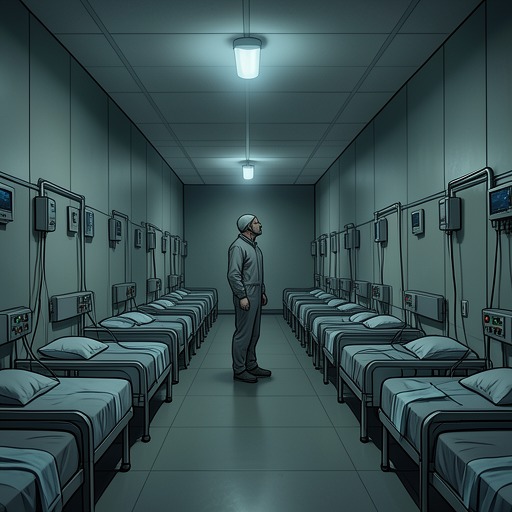
At six-thirty, the dormitory lights come on. Acute patients are quickly roused and put to work buffing floors, emptying ashtrays, and polishing marks from the walls. Patients with severe mobility impairments may be waiting for staff to move them, while others are described as being awakened by bed-wetting alarms and then cleaned and changed. The morning begins by assigning both labor and dependence before the patients have assembled for the day.
At six-forty-five, the shavers start. Acute patients line up alphabetically at the mirrors; patients who can walk but are chronically ill follow, and wheelchair users are brought in after them. Three especially dependent older patients are shaved in their lounge chairs in the day room, held in place with leather straps across their foreheads. The detail makes the routine’s efficiency inseparable from physical restraint: even a basic grooming task proceeds according to rank and staff control.
Bromden sometimes hides on Mondays and tries to evade the schedule. On other mornings, he decides it is safer to step into the line and let the route carry him along. He imagines the floor as filled with powerful magnets, moving the patients like arcade puppets. His choices are limited to concealment or compliance; the routine presses bodies into motion whether or not they willingly participate.
At seven, the patients go to the mess hall in a different order: wheelchair users first, then those who can walk, then the acute patients. Some acute patients carry trays to the wheelchair users. The three most dependent patients receive identical trays of mechanically softened food, with diet cards attached; aides feed them, sometimes faster than they can swallow. The meal is therefore another scheduled operation, calibrated to patients’ varying needs but also rendered harshly impersonal by repetition, identical trays, and hurried feeding.
Day-room duties, treatment, and observation
At seven-thirty, patients return to the day room and divide into assigned groups. Acute patients wait for cards and Monopoly; chronic patients wait for puzzles. Others are directed into recurring, highly individualized patterns of behavior. Bromden’s list includes a patient at the wall with his hands raised, another wagging his head, Scanlon working his hands as though assembling a bomb, and Dale Harding beginning to gesture before trapping his hands under his arms. The routines reduce distinctive men to actions that the ward seems to expect from them.
At seven-forty-five, aides move along the chronic patients’ line to attach catheters to those who will tolerate them. The tubing runs down trouser legs to plastic collection bags, which Bromden says it is his job to wash out at the end of the day. His assigned work thus extends the schedule beyond the patients who receive direct care: he is made responsible for cleaning and maintaining equipment used in the routine.
At eight, patients line up for medication, again in an established order. Acute patients go first, followed by chronic patients and wheelchair users; the three most dependent patients receive medication later in applesauce. The normal process leaves little room for questioning. When Maxwell Taber asks about two red capsules, Nurse Ratched grips his arm and presents his inquiry as childish hostility. She tells him he may leave if he will not take the medication orally. He later wonders about the capsules while Bromden recalls once hiding one under his tongue and finding, when he opened it, what looked to him like a miniature electronic component.
The schedule continues with cards and puzzles at eight-twenty, followed by other ward business. At eight-twenty-five, a patient’s remark about watching his sister bathe prompts other men at the table to compete to record it in the logbook. At eight-thirty, technicians arrive for laboratory work. These moments show that the routine includes not only treatment and recreation but the collection of personal disclosures. Patients’ words become material for the ward’s records, while medical procedures occupy their own appointed rooms and intervals.
At nine, young residents spend fifty minutes talking with acute patients about their childhoods. Nurse Ratched watches their presence with suspicion and makes notes; Bromden describes the ward’s machinery as faltering while they are there. When the residents leave at nine-fifty, the routine seems to regain its smoothness. Later, patients move in and out for occupational, physical, and other appointments in rooms whose irregular dimensions contrast with the precise timing around them. The schedule’s reach is broad, but its most revealing feature is how readily it resumes after interruption.
Time as an instrument of control
Bromden describes Nurse Ratched as able to alter the ward clock by turning a dial in a steel door. In his account, turning it up sends the hands racing and makes a day’s sequence repeat at impossible speed: shaving, meals, appointments, medication, and a brief interval for sleep. She is especially likely to accelerate time when a visit or a show might otherwise give patients a welcome stretch of experience. The routine is not merely regular; its pace can be manipulated according to the ward’s authority.
At other times, Bromden describes the dial being stopped so that the sun appears fixed and the clock hands remain near the same minute for weeks. Patients become unable to move, breathe, or swallow in his vision of this condition, while the only permitted motion is that of their eyes. Even a slight easing of the dial can feel worse than the stillness: an action across the room seems to take days, and Bromden struggles to rise from his chair to reach the latrine. His description turns enforced inactivity into bodily distress and humiliation.
He presents fog as another condition under which ordinary time loses meaning. On the day Randle Patrick McMurphy arrives, Bromden notes that the ward has not been subjected to its usual fog or time manipulation. Later, at the close of a day that has proceeded more normally, the clock reads four-thirty as the swing shift begins. Nurse Ratched dismisses the aides, removes her cap, gives the incoming nurse a note, and tells the patients to behave before turning up the music. The sequence ends with the machinery in the walls dropping into a lower gear. The return to an ordinary clock does not abolish the routine; it marks a temporary interval in which its control is less conspicuous.
Resistance and significance
The schedule’s classifications and consequences extend beyond the day room. Patients who are judged potentially assaultive can be sent to the Disturbed Ward, where Bromden describes time as measured by the repeated sound of a Ping-pong table and men pacing the same short routes. The contrast suggests that institutional discipline does not disappear when a patient is removed from the ordinary routine; it takes another form, more overtly confining.
The ward’s daily order is therefore significant as a system that governs conduct through repetition as well as punishment. It arranges meals, grooming, work, medication, recreation, and appointments, while also shaping who may move independently and how long an experience seems to last. Bromden’s occasional attempts to hide, his image of patients being moved like puppets, and the day when the usual time controls recede all make the routine’s operation visible. His eventual escape, marked by running for miles after breaking through a window, provides a stark contrast to the ward’s imposed schedules: movement and time become his own rather than activities assigned by the institution.